
Sleep Apnea Treatment in Beverly, MA
You stop breathing in your sleep, or someone told you that you do. Or you snore, wake up tired no matter how long you slept, and your doctor mentioned sleep apnea.
Most people never connect any of that with a dental office, and yet the airway that closes at night runs right through the territory a dentist works in every day: the jaw, the tongue, the palate, the bite.
At Kuljic DDS & Team in Beverly, we screen for sleep apnea, treat it with custom oral appliances, and address the muscle and structural patterns that drive it.
Why a Dentist for Sleep Apnea?
Sleep apnea happens when the airway collapses during sleep, and the airway does not collapse in a vacuum. The tongue falls back because of where it rests and how it works. The jaw sits where the bite puts it. The palate is shaped by how the face grew. These are dental structures, and a dentist trained in airway sees what drives the collapse, not just that it happens.
This is why the signs show up at dental exams years before anyone orders a sleep study. Worn teeth from grinding, a scalloped tongue, mouth breathing, a narrow palate, a jaw that sits back. We look at these in every exam, and they tell a story about your nights.
A physician diagnoses sleep apnea, and that part stays with medicine. A sleep study makes the diagnosis official, and we work alongside your doctor to get you there. What dentistry brings is treatment: an oral appliance built for your mouth that holds the airway open without a machine, and therapy that retrains the muscles that let it close. For mild cases and for people who cannot tolerate CPAP, that is not the backup plan. It is the first line.
What Sleep Apnea Actually Is
Sleep apnea means your airway closes while you sleep.
The tongue and the soft tissue at the back of the throat fall into the space where air should be moving, and the airflow stops. Your oxygen drops. Your body responds the only way it can, by jolting you toward waking until the airway reopens, and you gasp, snort, or shift position and fall back asleep. You remember none of it in the morning.
That is the cruelty of it. In a moderate case this happens dozens of times an hour, all night, every night.
Each of those events fires the same alarm your body uses for genuine danger. Adrenaline releases, blood pressure climbs, the heart rate jumps. You spend the night in a low-grade panic you are not awake for, which is why you can sleep eight hours and wake up feeling like you slept two.
Snoring sits at the mild end of the same problem, and it is not harmless. It means the airway is already partly obstructed and the tissue is vibrating as air forces its way through. Between snoring and full obstructive sleep apnea sits upper airway resistance syndrome, where the airway narrows enough to fragment your sleep without ever fully closing.
All three are the same story at different volumes, and all three are worth catching before they get louder.
Signs You Might Have It
Most people with sleep apnea do not know. The events happen while you are unconscious, so the evidence arrives secondhand, through a partner or through how you feel all day.
What you or your partner notice
How We Find It
Sleep apnea leaves fingerprints in the mouth, and we see them at ordinary dental exams years before anyone orders a sleep study. Teeth worn flat from grinding. A tongue with scalloped edges where it has been pressing against the teeth all night. A narrow, high palate. A jaw that sits back. Mouth breathing.
These are structural clues, and they tell us what your nights look like.
When we find them, we do not guess.
You wear a small sensor at home while you sleep, over several nights, and it records your oxygen level continuously. It shows us whether your oxygen is dropping, how far, and how often. Objective data, from your own bed, at no discomfort to you.
A CBCT scan shows the shape and the size of your airway, where it narrows, and what is crowding it. You cannot plan a treatment around an airway you have never looked at.
We examine how your tongue rests, how the chewing muscles work, and how the jaw and palate are shaped. Structure and habit feed the same problem, and both are visible in the mouth.
We measure the CO2 in your breath. Chronic mouth breathing and disordered breathing patterns shift it out of range, and that shows up long before a sleep study catches anything. It tells us how you breathe, not just whether you stop.
Our full screening protocol runs across three appointments, and we go through it in detail on the airway screening page.
One boundary worth stating plainly. A physician diagnoses sleep apnea, not a dentist, and a sleep study is what makes that diagnosis official. What we do is find the problem, measure it, and put the evidence in front of the right doctor. Then we treat it, which is where dentistry does the work medicine cannot.
How We Treat It
Treatment depends on what the screening found, how severe it is, and what you can actually live with night after night. A treatment you abandon in three weeks is not a treatment.
A custom oral appliance
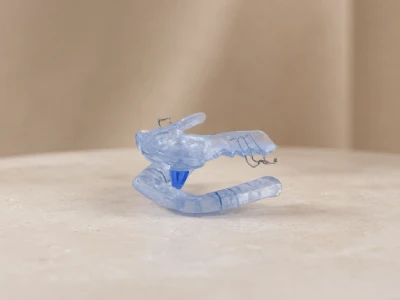
This is the core of what dentistry brings to sleep apnea.
The appliance fits over your teeth and holds your lower jaw slightly forward while you sleep, which pulls the tongue away from the back of the throat and keeps the airway open.
The clinical name for it is a mandibular advancement device.
It is a fitted appliance, not a strip of plastic. It has to hold a jaw in position all night, and that takes some structure. What it does not have is a mask, a hose, a machine, or a power cord.
We fit the Lamberg SleepWell appliance, adjusted to your jaw and your bite. It is small enough to travel with, and most people adapt to it within a couple of weeks.
This is not a compromise. The American Academy of Sleep Medicine recommends an oral appliance as the first-line treatment for primary snoring, for mild obstructive sleep apnea, and for upper airway resistance syndrome. For moderate and severe cases it is the recommended treatment for anyone who cannot tolerate CPAP, and a great many people cannot.
When CPAP does not work
We hear this constantly. The mask leaks, the pressure feels like drowning in reverse, the hose tangles, the noise wakes your partner, and the machine ends up in the closet. A CPAP that sits in a closet treats nothing.
If your physician has prescribed CPAP and you cannot wear it, tell them, and tell us. An oral appliance treats you every night you actually wear it, and that is the only measure that counts.
Myofunctional therapy
An appliance holds the airway open. It does not change why it closes.
When the tongue rests low, when the lips sit apart, when breathing runs through the mouth instead of the nose, the muscles that should hold the airway open have never learned to. Myofunctional therapy retrains them. Our therapists work with you over a series of sessions on tongue posture, on nasal breathing, on the muscles of the tongue, lips, and face.
It works alongside the appliance, and for some patients it reduces how much appliance they need.
Treating what is underneath
Sometimes the airway is narrow because the jaw is narrow, and no appliance fixes the shape of a jaw.
When the palate is high and constricted, palatal expansion widens it, which widens the nasal floor above it and opens the airway at the source. In children, functional orthodontics guides the jaws to develop with room for the tongue and the airway, which prevents the problem instead of managing it decades later.
This is what airway-focused dentistry means in practice. We treat the structure, not only the symptom.
Sleep Apnea FAQs
Yes, and for a large number of people a dentist is the one who treats it successfully. A physician makes the diagnosis, and a sleep study is what makes it official. Treatment is where dentistry comes in. An oral appliance is a dental device, fitted to your teeth and your jaw, and it is what the American Academy of Sleep Medicine recommends first for snoring, for mild sleep apnea, and for anyone who cannot wear CPAP.
For a formal diagnosis, yes, and we will help you get there. What we do first is screen: overnight oximetry at home, 3D imaging, and an examination of your airway and jaw. That tells us whether a sleep study is warranted and gives your physician real data to work from, rather than a hunch.
CPAP is more effective on paper. An oral appliance is more effective in practice for the many people who cannot tolerate CPAP, because the treatment that works is the one you use every night. A machine in a closet has an effectiveness of zero. For mild cases and for snoring, an oral appliance is the recommended first choice regardless.
The first few nights feel strange, and some people wake with a tender jaw or extra saliva while they adjust. That settles, usually within a couple of weeks. It is one device in your mouth, with nothing strapped to your face and nothing plugged into the wall.
Medical insurance often covers oral appliance therapy for diagnosed obstructive sleep apnea, since it is treated as a medical device rather than dental work. Coverage varies by plan. We check your benefits and tell you plainly what yours covers before you commit to anything.
Snoring means the airway is already partly obstructed. Sometimes that is all it ever is. Sometimes it is the early edge of something that gets worse over years. The only way to know which one you have is to measure it, and measuring it is not a difficult thing to do.
Almost everyone with sleep apnea feels fine, because they have no memory of the nights and no comparison to a good one. Meanwhile the oxygen drops, the blood pressure climbs, and the heart works overtime, for years. Your partner is not being dramatic. They are describing something you cannot see.
You do not have to keep waking up tired, and you do not have to sleep attached to a machine to fix it. Sleep apnea is one part of our airway and sleep dentistry, and a screening tells us what is happening in your airway at night.
Call (978) 922-4200 or request a consultation. If your partner has been telling you about this for years, bring them along. They have been paying attention.