
Root Canal Treatment in Beverly, MA
Tooth pain that will not settle, a tooth that aches with hot or cold long after you swallow, swelling in the gum beside it. These point to infection inside the tooth, and infection does not clear on its own.
Root canal treatment removes it, ends the pain, and keeps your natural tooth in place instead of pulling it. At Kuljic DDS & Team in Beverly, we treat the infection and rebuild the tooth afterward, planned as one job rather than two.
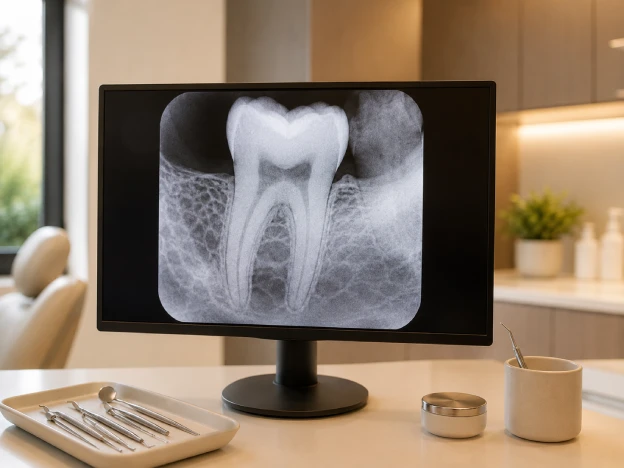
What is a Root Canal
Inside every tooth is soft tissue called the pulp, made of nerves and blood vessels. When decay, a crack, or an injury lets bacteria reach it, the pulp becomes inflamed and then infected. That is what causes the pain, and because the infection sits inside the tooth where the body cannot reach it, it spreads rather than heals.
Root canal treatment, also called endodontic treatment, clears the infected pulp out, disinfects the hollow canals inside the root, and seals them so bacteria cannot return. The tooth stays in your jaw, roots and all. What comes out is the infection, not the tooth.
This matters more than it sounds. A natural tooth root holds your jawbone active, keeps the neighboring teeth from drifting, and meets the opposing tooth exactly as it always has. Nothing replaces that as well as the tooth you already have.
What Causes the Infection
An infected pulp does not happen overnight. Bacteria have to get past the enamel and the dentin beneath it, and that takes time. A few things open the door:
Once bacteria reach the pulp, your immune system cannot get to them.
Blood supply to the inside of a tooth is limited, so the infection sits there protected, and it spreads instead of clearing. That is why waiting does not work, and why treatment is the only way out.
Signs You May Need a Root Canal
Not every infected tooth hurts, and not every ache means infection. These are the signs worth having looked at:
Some of these need attention today, not next week. Swelling that is spreading, pain that no medication touches, a fever alongside a bad tooth, or a bad taste from around the tooth all point to an infection on the move.
Call us at (978) 922-4200 and tell the front desk it is urgent. We will get you seen and get the pain under control.
Why Saving the Tooth Matters
Pulling the tooth is faster and it costs less that day. It is also the more expensive decision over time, and it starts a chain of problems that a root canal avoids entirely.

Nothing works quite like the tooth you were born with. Its root holds your jawbone active, and bone that carries no root begins to shrink within months. The teeth on either side lean into the space, the tooth above drops down to meet nothing, and your bite shifts across the whole arch. What began as one bad tooth becomes a chain of teeth out of position.
A natural root also carries a ligament that senses pressure, which is how you know when you are biting too hard on something. No implant or bridge reproduces that. The tooth you keep meets the opposing tooth exactly as it always has, and your bite carries on unchanged.
Then there is the cost. Pulling a tooth leaves a gap that has to be filled, and filling it means a dental implant or a bridge, both of which cost more than the root canal and crown that would have saved it. Leave the gap unfilled and you pay in a different currency, in bone and in the teeth that drift into it.
When a tooth cannot be saved, we tell you, and we plan the replacement properly. But when it can be saved, saving it is the better call almost every time.
The Procedure
A root canal takes one or two visits, depending on the tooth and how much infection is present. Here is what happens.
We examine the tooth and take an X-ray to see the roots, the canals inside them, and whether infection has reached the bone at the tip. This tells us what we are dealing with before anything begins.
We numb the tooth and the tissue around it completely. You feel pressure and movement during treatment, not pain.
We open a small access point in the top of the tooth, which gives us a path down into the canals where the infected pulp sits.
We remove the infected pulp, then clean and disinfect each canal along its full length. The canals are narrow and curved, so this stage takes care and time. It is the part that decides whether the treatment holds.
Once the canals are clean and dry, we fill them with a rubber-like material that seals them completely, so bacteria have nowhere to return to. A temporary filling closes the access point.
A treated tooth is hollow and brittle, and it will crack under normal chewing if it is left that way. We rebuild it, usually with a crown that covers it and takes the bite force. We fit that crown to how your teeth actually meet, so the tooth carries its share of the load and the ones around it are protected.
Because the treatment and the crown are both planned here, the tooth is finished properly rather than treated in one place and rebuilt in another.
Is It Painful?
Root canal treatment has a reputation it no longer deserves. The pain people associate with it is the pain of the infection, not the treatment. Most patients arrive hurting and leave relieved, and that is the actual experience.
You are numb throughout, so you feel pressure and movement rather than pain. Sedation is available if dental work makes you anxious, and you can tell us at any point during treatment if something does not feel right.
Afterward, the tooth is tender for a few days, the way anything is tender after inflammation settles. Over-the-counter medication handles it, and it fades. What does not come back is the deep, throbbing ache that brought you in.
After Your Root Canal
The tooth will be tender for a few days while the inflammation settles, and that is normal. Over-the-counter medication handles it. What you should not feel is the deep ache that brought you in.
A few things help while it settles:
Until the tooth is permanently restored, keep hard chewing off it. A temporary filling is not built to take a full bite load.
Brush and floss the tooth as normal. Keeping the area clean helps the tissue around the root settle.
If we give you antibiotics or pain medication, finish the course as directed.
This is the one that matters most. A treated tooth is hollow and brittle, and it cracks under normal chewing if it is left with only a temporary filling. Do not put this off.
Call us if the pain gets worse instead of better, if swelling appears or spreads, or if the temporary filling comes loose.
These are easy to sort out early and harder to sort out late.
Root Canal FAQs
The tooth is numb throughout, so you feel pressure and movement rather than pain. The ache people associate with root canals is the infection, not the treatment. Most patients arrive hurting and leave relieved.
One or two visits, usually around an hour to ninety minutes each, depending on the tooth. Molars have more canals than front teeth, so they take longer.
A treated tooth is hollow, and hollow teeth crack. A crown covers the tooth and takes the bite force, which is what keeps it in your mouth for the long run. Skipping it is the most common reason a root-canaled tooth is eventually lost.
You can, and it costs less that day. But the gap has to be filled afterward with an implant or a bridge, both of which cost more than the root canal and crown, and neither works quite as well as the tooth you already have. When a tooth can be saved, saving it is almost always the better call.
A properly treated and crowned tooth lasts for many years, often for the rest of your life. What decides it is the quality of the seal, the crown that protects it, and the same home care that keeps your other teeth healthy.
It is uncommon, but it happens, usually when a canal was hard to reach or a new crack lets bacteria back in. The tooth can often be retreated. If it cannot, we tell you honestly and plan the next step with you.
Yes. You may have come across claims online linking root canals to systemic illness. Those claims trace back to research from the 1920s that was discredited long ago and has not held up to modern study. Leaving an infected tooth untreated is the thing that carries real risk, since the infection spreads into the bone and the bloodstream.
A root canal is one way we keep a damaged tooth in your mouth. See the full range of our restorative dentistry if you want the wider picture.
If a tooth is hurting, do not wait it out. Infection does not resolve on its own, and the longer it sits, the fewer options are left. Call (978) 922-4200 or request a consultation, and we will get you seen.