
Implant-Supported Dentures in Beverly, MA
A denture that rests on the gums moves. It shifts while you chew, it clicks when you speak, and adhesive only takes you so far, especially on the lower jaw.
Implant-supported dentures solve that at the source. Dental implants set into the jawbone hold the denture in place, so it stays where it belongs and lets you bite with something close to natural strength.
At Kuljic DDS & Team in Beverly, we plan the implants and the denture together, so the finished result fits your bite and holds it.
What are Implant-Supported Dentures?
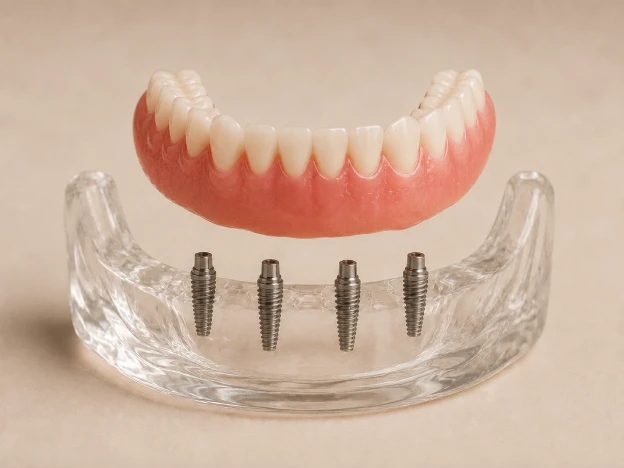
An implant-supported denture is a full denture held by dental implants instead of resting on the gums. A conventional denture sits on the ridge and relies on suction and adhesive to stay put. An implant-supported denture attaches to titanium posts anchored in the jawbone, which take the load the way natural tooth roots once did.
That difference changes everything about how the denture behaves. It does not lift when you bite into something firm, and it does not slide when you talk. It also does something a conventional denture cannot: because the implants load the bone, they slow the bone loss that follows tooth loss, which is what causes a gum-supported denture to loosen year after year.
If you already wear a denture and it has never felt secure, this is usually the answer. It is also worth considering from the start, before you commit to a conventional denture, since building on implants from the beginning avoids years of adjustment and relining.
How Implants Anchor a Denture
Implants can hold a denture in two ways, and the difference comes down to whether the denture stays in your mouth or lifts out. Both are anchored, both are stable, and which one suits you depends on your bone, your budget, and how you want to live with it day to day.
Removable (Snap-On) Dentures
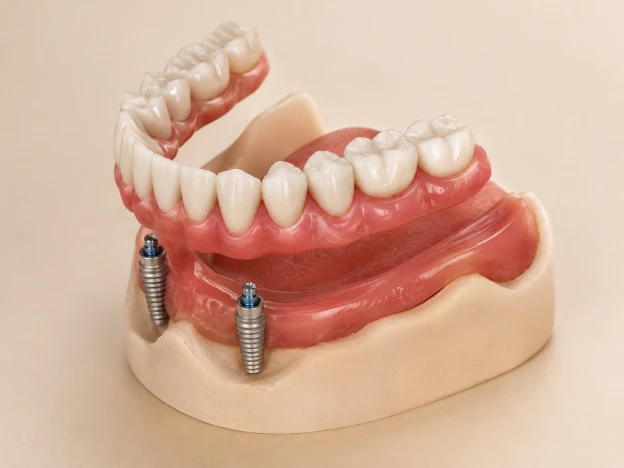
A snap-on denture clips onto implants and lifts out when you want it out. Two to four implants per arch carry attachments, and the denture snaps onto them and holds firm while you eat and speak. You take it out at night and to clean it, the same routine as a conventional denture, but without the movement and without the adhesive.
This option needs fewer implants, which keeps the cost lower, and it works well when bone volume is limited. It is the most common step up for someone whose lower denture has never stayed put.
Fixed Implant Dentures
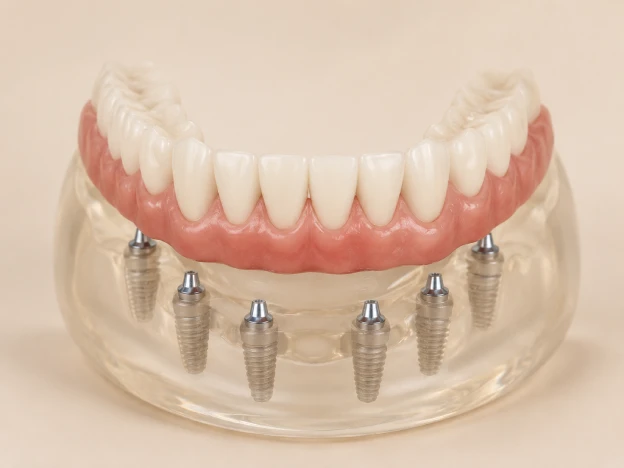
A fixed denture stays in your mouth. It is secured onto four to six implants and only your dentist removes it, at checkups. You clean around it the way you would natural teeth, with a brush, floss threaders, and a water flosser under the bridge.
Because more implants share the load, a fixed denture handles the strongest bite of any denture option, and most people stop thinking of it as a denture at all. It asks more of your bone, so it may call for grafting first if the ridge has already shrunk.
All-on-4
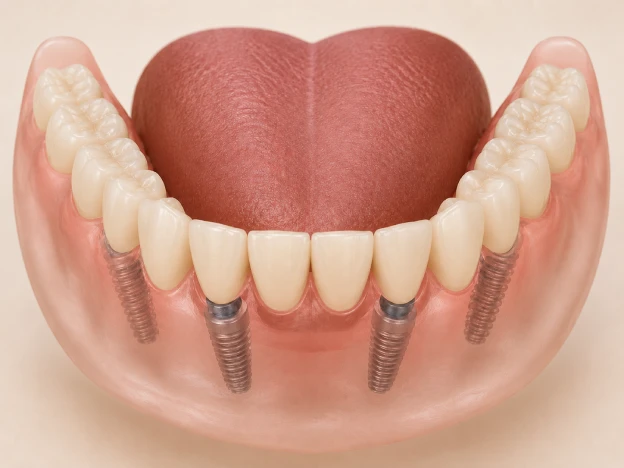
All-on-4 is a fixed denture built on exactly four implants, placed at an angle so they anchor into the denser bone at the front of the jaw. Tilting the back implants means they reach solid bone without needing the height that a straight implant would, which is why All-on-4 often works for someone who was told they need a bone graft first.
The other advantage is speed. In suitable cases a temporary fixed denture goes on the same day the implants are placed, so you leave with teeth rather than waiting through months of healing without them. The final denture follows once the implants have fused.
Why Implants Make the Difference
An implant-supported denture costs more than one that rests on the gums, and it is worth understanding exactly what that buys you. The difference shows up every day, and it compounds over the years.
Add it up and the math often works out in favor of implants.
The upfront cost is higher, but you are not replacing and relining a denture every few years, and what you get in the meantime is a set of teeth you can forget you are wearing.
How it Works
Getting an implant-supported denture takes place over several appointments, spread across the months your jaw needs to fuse with the implants. Here is how it goes.
We take a CBCT scan that maps your jawbone in three dimensions, showing exactly how much bone you have and where the nerves run.
From that scan we plan how many dental implants you need, where they go, and which type of denture suits your case. If the bone is thin, we plan grafting into the timeline now rather than discovering it later.
On the day of surgery, we place the implants using a guide built from your scan, so each one lands where it was planned.
You are numb throughout, and sedation is available. If teeth need removing, we do that in the same visit.
Over the following months your bone grows around the implants and locks them in place.
You wear a temporary denture during this time, so you are never without teeth. In selected cases, a fixed temporary goes on the same day the implants are placed.
Once the implants have fused, we attach the connectors and fit your final denture.
We check the bite, adjust until it meets correctly, and show you how to clean and care for it.
Who Is a Candidate?
Most people who have lost the teeth in an arch, or who are about to, can have an implant-supported denture. What decides it is not your age but the state of your bone and gums, and your general health. At your consultation, a CBCT scan tells us exactly what we are working with.
Three things matter most:
Already wearing a denture and tired of it? That is one of the most common reasons people come to us for this, and having worn one for years does not disqualify you. Neither does being told elsewhere that you lack the bone. Bring us the case and we will tell you honestly what is possible.
Cost of Implant Support
An implant-supported denture costs more upfront than one that rests on the gums, and the honest figure comes after a scan and an exam.
What moves the number:
How many implants
A snap-on denture on two implants costs less than a fixed denture on six. This is usually the biggest single factor.
Whether you need grafting
If the ridge has already shrunk, rebuilding bone adds a stage and a cost. An All-on-4 approach sometimes avoids it, which is one reason we plan from a 3D scan before quoting anything.
Removable or fixed
A fixed denture uses more implants and a more involved restoration, so it sits at the higher end. A snap-on gives you most of the stability for less.
What comes first
If teeth still need removing, or gum disease needs treating, those steps carry their own cost and go into the plan.
Weigh it against what a conventional denture costs over time. That one gets relined as the bone shrinks under it, and replaced every several years, and it never stops moving.
An implant-supported denture is built once, on a foundation that holds. After your exam you get a written estimate with the options side by side, and we go through financing and what your insurance covers, the same as we do for any denture.
Real Patient Results
Every case below is work done in our office. Here is what this patient was facing, and what we did about it.

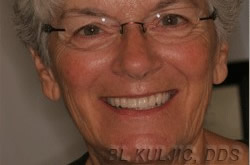
From loose dentures to implant-supported stability
She struggled to chew and speak, and wanted a solution that would hold.
Because the prognosis for her remaining teeth was poor, we moved her to an implant-supported denture, which anchored the fit and gave her back the chewing strength and clear speech she had lost.
Implant-Supported Denture FAQs
You are numb throughout the placement, so the procedure itself is comfortable, and sedation is available if you want it. Afterward there is soreness for a few days, which over-the-counter medication handles. Most people find it easier than they expected.
Several months, most of which is healing rather than appointments. Your bone needs time to fuse with the implants before the final denture goes on. You wear a temporary denture throughout, and in selected cases a fixed temporary goes on the same day the implants are placed.
Yes, and that is the most common reason people come to us for this. Having worn a conventional denture for years does not disqualify you. It may mean the ridge has shrunk and needs grafting, or that an angled approach suits your case better, which is exactly what the scan tells us.
Two to four per arch for a snap-on denture, and four to six for a fixed one. The number depends on how much bone you have, where it is, and which type of denture you want. We settle this from your 3D scan, not from a guess.
That depends on the type. A snap-on denture lifts out for cleaning and overnight, the same as a conventional one. A fixed denture stays in, and only we remove it at checkups. Both are anchored, so neither one slips while you use it.
The implants themselves last decades with good care, since bone holds them permanently once fused. The denture on top wears like any restoration and is replaced or refreshed when the time comes, but the foundation underneath stays.
Hearing that elsewhere is common, and it is rarely the end of it. Grafting rebuilds bone, and an All-on-4 approach angles the implants into denser bone that is still there, which avoids grafting in a good number of cases. The scan tells us which route works for you.
Implant-supported dentures are one of several ways we rebuild a full arch. See the full range of our restorative dentistry if you are still weighing your options.
If your denture has never felt secure, or you want to skip that stage altogether, a scan and a conversation will tell you what is possible. Call (978) 922-4200 or request a consultation.