
TMJ Treatment in Beverly, MA
Jaw pain that keeps coming back. A jaw that clicks, pops, or locks when you open. Headaches on waking, teeth worn flat, a bite that has never felt settled. These get treated as separate problems, and they are usually one.
Your jaw joints, chewing muscles, teeth, and bite work as a single system. When that system is under strain, the symptoms show up wherever it is weakest, which is why they rarely point straight at the cause.
At Kuljic DDS & Team in Beverly, we find what is driving your symptoms before we treat them. Understanding first, treatment second. That order is the whole point.

Who Do You See for Jaw Pain?
Most people with jaw pain do not know who to call. Their physician says to see a dentist. Their dentist says it is muscular and hands them a nightguard. Somebody suggests an ENT because of the ear. Nobody owns the problem, and it keeps coming back.
Part of the confusion is that nobody's job title is TMJ doctor, and there is no dental specialty called TMJ specialist. Those are the words people reach for because they need a name for what they are looking for, and the professions never gave them one. What exists are dentists who work in jaw function and bite mechanics, physicians who treat the pain, and orofacial pain specialists for the difficult cases. TMJ sits on a line that medicine and dentistry have never drawn cleanly, and most of the people you have seen were looking at one piece of it.
Here is the honest answer. The everyday version of this problem, the clicking, the clenching, the morning soreness, the worn teeth, the bite that never settles, comes down to how your teeth meet, how your muscles work, and how force moves through the joint. That is dentistry.
A dentist working in this area examines the joint, the muscles, and the bite together, because those three decide each other. A physician can rule out other causes and help with pain. An ENT can rule out the ear, and often does, which is how many people end up here. But neither of them examines your bite, and the bite is usually where the strain starts.
Some cases do belong elsewhere. Arthritis in the joint, nerve pain, and injury after trauma call for other care, and when that is the picture we say so and refer you. But if your jaw hurts, clicks, or locks, and nobody has looked at how your teeth come together, that is the piece that has been missing.
When the Jaw and Bite Are Out of Balance
Your jaw joints, chewing muscles, teeth, and bite are built to work together. When that system is under strain, it does not always complain where the problem is. Pain shows up in the ear, the temple, the neck, or a tooth that turns out to be perfectly healthy. That is why jaw problems get chased from one specialist to the next.
Some people feel it in the joint itself. Others wake with a sore jaw, or notice their teeth wearing flat, or find that their bite has never felt settled since a crown went in. The damage builds slowly, which is exactly why it goes unnoticed until it is advanced.
The goal is not just to quiet the symptoms. It is to find what is putting the strain on the jaw and bite in the first place.
What This Feels Like
Looking for the Source of Jaw and Bite Stress
Jaw problems rarely come from one thing. The joint, the muscles, the teeth, and the way your bite closes all load each other, and strain in one shows up in another. Treat the symptom without finding the source and it comes back, which is why so many people have been through a nightguard, a course of painkillers, and a referral or two, and are still here.
A TMJ and bite evaluation looks at the whole system rather than the part that hurts.
What we examine
How your jaw opens, closes, and travels. Where it clicks, where it catches, how far it goes before it stops, and whether the two sides move the same way.
Where your bite makes contact first, where the pressure concentrates, and whether the teeth guide the jaw into a position it can hold comfortably or one it has to brace against.
Which chewing muscles are overworked, where they are tender, and what pattern of clenching or grinding they point to. Muscle is where most jaw pain actually lives.
Flattened, chipped, or cracked teeth tell us how much force is going through the bite and where it lands. Teeth record the history of a bite better than any patient can describe it.
Crowns, fillings, and veneers either fit the bite or fight it. Dental work that keeps failing is usually not bad dentistry. It is dentistry placed into a bite that was already under strain.
How Treatment Takes Shape
There is no single treatment for TMJ, and anyone who offers one before examining you is guessing. What you need depends on what the evaluation finds: where the strain starts, how long it has been building, and what it has already damaged.
Most plans draw on one or more of these.
Bite stabilization
When the bite closes unevenly, the joint and muscles compensate for it every time you swallow, which is thousands of times a day. The first job is mechanical: a bite that closes evenly and rests in a position the jaw can hold without bracing.
A custom oral appliance
A splint or orthotic worn over the teeth. It takes the load off the joint, stops the teeth from grinding against each other, and gives overworked muscles a chance to release. It is genuinely useful, and it is not the whole answer. An appliance manages the force. It does not explain where the force is coming from, and that is what we are looking for.
Rebuilding worn or damaged teeth
When clenching and grinding have flattened, chipped, or cracked teeth, restoring them is part of restoring the bite. Rebuilt teeth are shaped to meet correctly, not just to look right, so the bite they create is one the jaw can live with.
Correcting tooth position
Sometimes the teeth themselves hold the jaw in a strained position, and no appliance or repair changes that. Moving them changes the forces at the source. Whether this applies to you depends entirely on what the evaluation finds.
We recommend what the findings call for and nothing more. If your case is straightforward, we say so. If it needs more, we show you why before you agree to anything.
Stability Before Aesthetics
A comfortable bite is not just about how the teeth line up when you look at them. It is about where the force goes every time you close, and force does not care how the smile looks.
Put a crown, a veneer, or a bridge into a bite that is already under strain, and the strain finds it. The new work takes the load the old tooth was taking, and it fails the same way, only faster, because porcelain does not flex. That is the story behind most dental work that keeps chipping, loosening, or breaking. It was placed correctly into a bite that was working against it.
So when there are signs of instability, worn teeth, clenching, a bite that has never settled, we look at how the system functions before we change how it looks. A smile built on a bite that works stays where you put it. One built on a bite that does not, comes back to us in a few years, and you pay for it twice.

Real Cases Where Bite Function Guided the Plan
TMJ and bite-related concerns often affect more than comfort alone. When the bite is unstable, it can influence chewing, tooth wear, muscle tension, and the long-term success of cosmetic or restorative treatment.
These examples show how bite function helped guide the treatment plan.
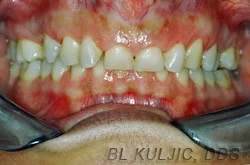

Adult orthodontics and porcelain veneers with TMJ
She was self-conscious about her teeth and wanted a result that would last, achieved as conservatively as possible.
We treated the bite first with orthodontics, which resolved her TMJ symptoms and restored comfortable chewing. With the function settled, four porcelain veneers on the upper front teeth gave her the fuller smile she came in for.
Adult Orthodontics for Pain and TMJ
She came to us with significant pain that had gone on for years, through her face, jaws, neck, and shoulders.
Her bite was holding the jaw in a position it could not sustain. We corrected the bite with orthodontics and stabilized the TMJ, which took away the strain driving the pain and gave her back the ability to chew without it.


Every case is different. A TMJ and bite evaluation is what tells us whether your symptoms come from the joint, the muscles, the bite, worn teeth, or several of them together.
Is This Approach Right for You?
This kind of evaluation makes sense when the problem keeps coming back. One rough week with a sore jaw is normal. A pattern that returns is your jaw telling you something, and it is worth finding out what before treating around it.
It is also the right first step before cosmetic or restorative work if there are signs of clenching, grinding, tooth wear, or a bite that has never felt settled. Better to find that now than after the veneers are on.
This is likely your situation if
Care That Works Together with TMJ Treatment
Jaw and bite problems rarely stay in their lane. They overlap with sleep, with tooth position, and with the state of the teeth themselves. When they do, we treat them as one plan rather than four separate appointments.
How you breathe at night drives clenching more often than people realize. A jaw that braces to keep the airway open all night is a jaw that wakes up sore.
When years of clenching have worn the teeth down and the bite along with them, rebuilding both together is what restores function.
Where the teeth sit decides where the jaw has to go to meet them. When position is the problem, moving the teeth fixes it at the source.
Worn, cracked, and repeatedly repaired teeth are usually a bite problem wearing a restorative disguise. Fixing them properly means fixing what broke them.
TMJ & Bite Function FAQs
TMJ refers to the temporomandibular joint, which connects the lower jaw to the skull. People use "TMJ" to describe jaw pain, clicking, popping, stiffness, muscle tension, or bite-related discomfort. The clinical name for the disorder is TMD, and the care for it goes by several names, including temporomandibular joint therapy. They describe the same thing.
There are reliable clues: teeth that don't come together evenly, a bite that never feels settled, clenching or grinding, worn or chipped teeth, headaches, or jaw soreness on waking. Any one of them says the bite is worth examining. The evaluation then shows whether bite forces are the source of your pain or a passenger alongside something else.
Yes, and it's one of the most destructive forces in dentistry. Clenching can load teeth with several times normal chewing pressure, at night, for hours, with nothing to chew. Over time that means worn enamel, cracks and chips, sensitivity, sore muscles, and dental work that keeps failing. The damage is slow, which is exactly why it goes unnoticed until it's advanced.
Not always, and this is where TMJ care most often goes wrong. A custom appliance protects the teeth and can calm the muscles, and for some patients it's exactly the right tool. But a nightguard manages the force; it doesn't explain where the force is coming from. If clenching is driven by bite imbalance or disturbed breathing during sleep, the guard alone treats the symptom. That's why we evaluate first and recommend second.
Sometimes, and when it does, it's because alignment was part of the problem. If teeth meet in a way that forces the jaw into a strained position, moving them changes the forces at the source, which no appliance or repair can do. Whether that's your case depends on what the evaluation finds: the cause of the stress, the position of the teeth, and how alignment is affecting function.
When any of these keep coming back: jaw pain, clicking or popping, headaches, facial tension, clenching, grinding, worn or cracked teeth, or a bite that feels off. One episode after a stressful week is normal. A pattern that returns is your jaw telling you something, and it's worth finding out what, before treating around it.
No. You can book an evaluation directly. Many people arrive after their physician, their dentist, or an ENT has looked at one piece of the problem and not found the answer, which is usually because nobody examined the bite.
Jaw pain that keeps coming back is not something you have to manage indefinitely. It is a system under strain, and strain has a source. Finding it is the whole job.
Call (978) 922-4200 or request a consultation, and we will start by working out what is actually driving your symptoms.