
Full Mouth Reconstruction in Beverly, MA
When several teeth are worn, broken, missing, or held together by dental work that keeps failing, fixing one tooth at a time stops working. Full mouth reconstruction rebuilds the whole system: the teeth themselves, the bite that loads them, and the appearance that follows from both.
Before anything is rebuilt, we answer the question most patients have never been asked. Why did it break down in the first place? That answer decides the plan, the sequence, and how long the result lasts.
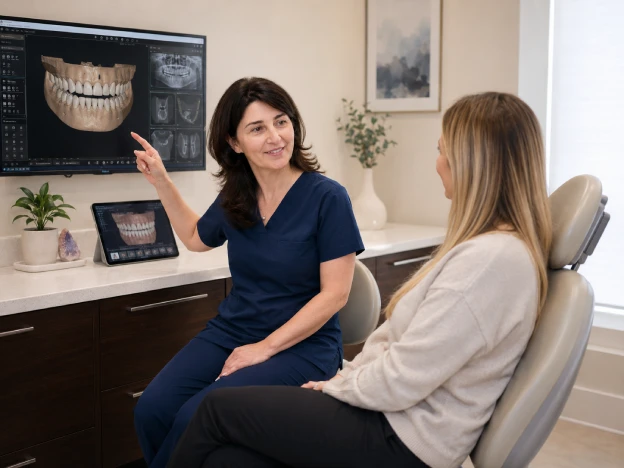
Why Dental Work Keeps Failing
Teeth do not break down by accident. They break down under force.
A bite that closes unevenly concentrates chewing pressure on a few teeth instead of spreading it across all of them. Clenching and grinding multiply that pressure, night after night, on the same handful of contacts. Enamel flattens. Cusps chip. Crowns fracture at the margin. Fillings loosen. The teeth carrying the most load fail first, and the ones next to them inherit the job.
Most patients have lived with this for years and were told the cause was stress, or age, or bad luck. What they were rarely told is that their bite is the thing doing the damage.
Porcelain Does Not Bend
A natural tooth flexes slightly under load. Porcelain and zirconia do not. They hold, and then they fail.
This is why a crown that fractures once fractures again when it is replaced with an identical crown on the same tooth, under the same bite, loaded the same way. The restoration was never the problem. The force was.
Replacing the work without changing what loads it means paying for the same dentistry twice.
Rebuild the Bite, Then Rebuild the Teeth
Full mouth reconstruction starts where single-tooth dentistry stops. We map how your jaw closes, which teeth take the first contact, how far the wear has progressed, and how much support each tooth has left. If the bite is unstable, we stabilize it before final restorations are made, so the new work is protected from the day it goes in.
This is the same functional evaluation behind our TMJ and bite treatment, applied to a mouth that has already paid the price for years of uneven load.
Signs You Need More Than Another Repair
If the answer to the last broken tooth was another crown, and the answer to the one before that was another crown, the pattern is the diagnosis.
Dental Work That Keeps Breaking
Crowns fracture. Bridges loosen. Fillings fall out. Each repair holds for a while, and then the next one goes.
Teeth That Look Shorter Than They Used To
Front teeth flatten, edges chip, and the smile shows less tooth every year. That is wear, and wear is measurable.
Missing Teeth You Have Stopped Replacing
Every gap shifts the teeth around it and hands their chewing load to the teeth that remain.
Chewing on One Side
Patients rarely notice when they made the switch. The side you avoid is the side that hurts. The side you use is the side that wears out next.
Jaw Soreness, Clenching, Morning Headaches
Your jaw reports the force long before your teeth do. Waking up tight, sore, or with a headache is that force showing itself.
A Smile You Hide
Worn, dark, chipped, or missing teeth change how you speak, eat, and sit for a photograph. That is a clinical finding, not vanity.
How the Plan Is Built
A reconstruction is designed before a single tooth is prepared. The records come first, the diagnosis second, the drill last. Reversing that order is how patients end up rebuilding the same mouth twice.
The Records
We take a full radiographic series and CBCT imaging, clinical photographs, digital scans, and mounted study models.
Together they show what a single X-ray never does: where your jaw actually closes, which teeth touch first, how much tooth structure is left under each existing crown, and how much bone supports each root.
The Diagnosis
Every tooth gets a prognosis. Some are sound. Some are restorable. Some are past saving and are holding the plan hostage.
We also identify the force pattern behind the breakdown, because the reconstruction has to be built to survive it, not to ignore it.
The Blueprint
We design the finished bite before we build it. Tooth length, contact points, chewing surfaces, and the position your jaw is most comfortable closing into are worked out on models and in provisional restorations, where changes cost nothing.
Only when that design proves itself in your mouth do the final restorations get made.
The Sequence
The plan then answers the practical questions. What is treated first, what waits, what has to be stabilized before anything permanent goes in, and what you will look and chew like at every stage in between.
You leave the consultation knowing the whole route, not just the first step.
What a Reconstruction Involves
No two reconstructions use the same combination. Yours depends on how many teeth are left, what shape they are in, and how far the bite has drifted. These are the components the plan draws from.
Crowns and Bridges
Rebuild broken and heavily restored teeth, and close short spans where teeth are missing.
In a reconstruction they are designed to a bite that has already been corrected, which is the difference between a crown that lasts and a crown that fails the way the last one did.
Dental Implants
Replace missing teeth at the root, so the bone is loaded and the neighboring teeth carry nothing extra.
Implants also anchor larger restorations that would otherwise depend on teeth too compromised to carry them.
Dentures or Implant-Supported Dentures
Restore chewing and facial support when most or all teeth are gone. Implant-supported options fix the denture to the jaw, which returns bite force closer to what natural teeth deliver.
Porcelain Veneers
Refine the front teeth once the foundation underneath them is stable. Veneers placed on an uncorrected bite are the most expensive way to learn that lesson.
Bite Stabilization
An orthotic or splint tests the corrected bite position before the corrected bite is built in porcelain. Patients wear the new position, chew in it, sleep in it, and confirm it holds. This step is what protects everything placed after it.
Orthodontic Movement and Clear Aligners
Moving a tooth into a better position costs less tooth structure than grinding it down and covering it. Limited tooth movement before restorations means less tooth removed and better long-term support.
Treatment in Phases
Full mouth reconstruction is not one appointment and not one payment. It is a sequence, and the sequence is deliberate.
Unstable and painful areas are treated first. The bite is stabilized and tested. Teeth without a future are removed and replaced. Only then are the definitive restorations made, on a foundation that has already proven it works. Patients who need to spread the treatment out do so along the same lines, completing one phase, living in it, and beginning the next when they are ready.
Phasing also answers the question everyone arrives with. The cost of a reconstruction is the cost of its parts, and you approve those parts one phase at a time, with the full plan visible from the start. Nobody is asked to commit to the end of a road they have not seen.
How the Process Typically Moves Forward
-
1. Comprehensive Evaluation
Records, imaging, mounted models, bite analysis, and a prognosis for every tooth.
-
2. Diagnosis and Written Plan
The phases, the sequence, the timeline, and the cost of each phase, presented before treatment begins.
-
3. Stabilization
Painful and failing teeth are addressed, and the corrected bite position is tested in provisional restorations or an orthotic.
-
4. Definitive Restoration
Crowns, bridges, implants, veneers, and dentures are completed to the bite that has already been proven.
-
5. Maintenance
The result is monitored, the bite is checked, and protection is provided against the force that caused the original breakdown.
Real Cases Where One Plan Replaced Years of Repairs
These four reconstructions were completed by Dr. Kuljic. Each one started the same way: a patient who had run out of individual fixes and needed the whole mouth planned at once.
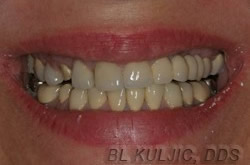
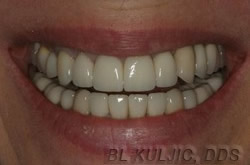
Failing Bridge Replaced with Implants, Bite Repositioned
Years of separate treatments had left this patient with a smile she disliked and a bite she could not chew on comfortably. She wanted one plan that solved all of it, not another repair.
We replaced the failing upper left bridge with implants and rebuilt her bite into a position her jaw could close into repeatably. Old crowns were replaced with new ones matched to her remaining teeth. She chews on both sides and smiles without covering her mouth.
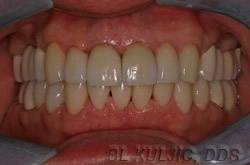
Full Ceramic Rehabilitation with Periodontal Treatment
This patient arrived with several problems running at once: compromised gum health, worn and failing teeth, and a smile he had stopped showing.
We treated the periodontal disease first, then rebuilt the dentition with a combination of ceramic crowns, porcelain veneers, and bridges. Function came back with the foundation, and the appearance followed. The result is a full, healthy smile built on tissue that can hold it.
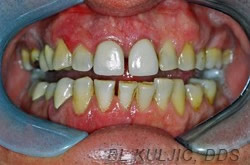
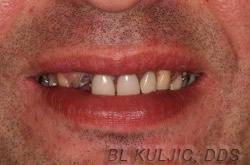
Short-Term Orthodontics, Then Implants, Replacing Partial Dentures
This patient had lost a significant number of teeth and was living with partial dentures that were uncomfortable and looked artificial. The remaining teeth had drifted into the spaces.
We moved the teeth back into position with short-term orthodontics first, which created the room and the alignment the implants needed. Implants then replaced the missing teeth and gave him a fixed result with long-term stability. The partials are gone.
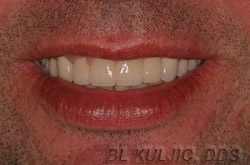
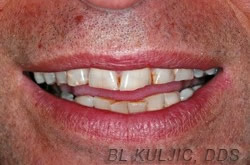
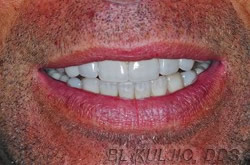
Full Mouth Rehabilitation, Crowns and Veneers to a Corrected Bite
This patient wanted a brighter, fuller smile, and wanted to chew comfortably again.
We restored the bite to its optimum position and rebuilt the arches with all-ceramic crowns and porcelain veneers designed to that corrected position. The smile is the visible half of the result. The half you cannot see is a bite that no longer destroys the work sitting on it.
Full Mouth Reconstruction FAQs
It is a single plan that rebuilds every part of the mouth that needs rebuilding: damaged and worn teeth, missing teeth, failing restorations, and the bite that loads all of them. It is not a procedure. It is a diagnosis followed by a sequence.
Cosmetic dentistry changes how teeth look. Full mouth reconstruction changes how they work, and the appearance follows from that. Veneers placed on a bite that is destroying teeth will be destroyed by the same bite.
No. Healthy teeth stay healthy teeth. The plan treats what is damaged, replaces what is missing, and protects what is sound. We give every tooth a prognosis before treatment begins, and you see that list.
It depends on how many teeth are involved and whether the bite needs to be stabilized and tested before the final restorations are made. Straightforward cases finish in a few months. Cases involving implants, bone healing, or tooth movement run longer, because biology sets that schedule and we do not rush it. You get a timeline with the plan, not after it.
The cost is the sum of the treatments in your plan, and no two plans are the same. We give you a written estimate after the consultation, broken down by phase, so you see what each stage costs before you approve it. Insurance covers part of most reconstructions, particularly the restorative and periodontal components, and we tell you exactly what your plan covers rather than leaving you to find out.
Yes, and most patients do. Treatment is organized so that each phase stands on its own: you finish it, you live in it, and you begin the next one when you are ready. What does not change is the destination, because it was designed at the start
That depends on whether the cause was treated. A reconstruction built onto an uncorrected bite fails the way the original dentistry failed, only more expensively. That is why the bite is corrected and tested before anything final is made, and why maintenance protects it afterward.
Full mouth reconstruction is the point where restorative dentistry stops treating teeth and starts treating a mouth. If your dental work keeps failing, the next crown is not the answer. The bite that broke the last one is.
Bring us the whole history: the teeth that broke, the work that did not hold, and what you were told each time. We will tell you why it happened and what it takes to fix it for good.
Call (978) 922-4200 or request a consultation, and we will get you seen.