
Dental Implants in Beverly, MA
A missing tooth changes how you chew and speak, and it lets the neighboring teeth drift into the gap over time. A dental implant replaces that tooth at its root, rebuilding full function with a result that looks and performs like what you lost.
At Kuljic DDS & Team in Beverly, we plan every case around your whole bite. A CBCT 3D scan maps your bone before treatment begins, and guided placement sets the implant precisely. Because the surgical and restorative phases both happen under our roof, your final tooth is built to fit your occlusion, not just fill the space.

Benefits of Dental Implants
An implant does more than close a gap. It restores the mechanics a natural tooth handled, and it protects everything around the space.
Am I a Candidate?
Most healthy adults qualify for dental implants. At your consultation, we take a CBCT 3D scan to measure your available bone, then review your medical history and examine the health of your gums. If another dentist told you that you lack the bone for implants, grafting rebuilds the missing volume, and treatment becomes possible again.
You are a strong candidate if you want a replacement that stands on its own, without leaning on the teeth beside it. Implants ask one thing of you in return: steady home care and regular checkups, the same habits that keep natural teeth healthy.
Dental Implant Options
Your options come down to how many teeth are missing and what you want the replacement to do.
Single implant and crown
Replaces one missing tooth on its own post, without involving the teeth on either side. You brush and floss it like a natural tooth. When a single tooth is gone, this is the most conservative fix available.
Implant-supported bridge
Spans a gap of several teeth on two or more implants, with no healthy teeth ground down to anchor it. When the gap is too wide for one implant and a traditional bridge would overload the teeth beside it, these implants carry the load instead.
Implant overdenture (snap-in)
Two to four implants hold a removable denture firmly in place. It snaps onto the implants and stays put while you eat and talk, then lifts out for cleaning. Chewing and speech improve sharply over a conventional denture that rests on the gums alone.
Full-arch fixed (All-on-X)
Four to six implants carry a complete fixed arch that never comes out. For a patient who has lost most or all of one row of teeth, it rebuilds a full set that stays in the mouth day and night.
The right choice depends on how many teeth are missing, the condition of your bone, and what matters to you day to day. We map the scenarios against your 3D scan, lay out the trade-offs, and put timelines and costs in front of you, so the decision is yours to make with the full picture.
Real Patient Results
Every case below is work done in our office. Here is what was going on, and what we did about it.


Front tooth replaced with a single implant
She wanted the most reliable, lasting fix for a broken front tooth. We removed the remaining root and placed an implant matched to the tooth beside it, rebuilding her smile with a result that holds.
Failing tooth replaced, smile brightened
He wanted to replace a failing front tooth and lift the look of his smile at the same time. We placed an implant where the tooth was failing, whitened his teeth, and added composite bonding where roots had become exposed.
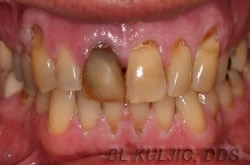
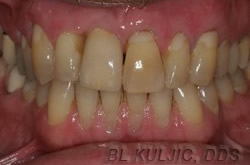
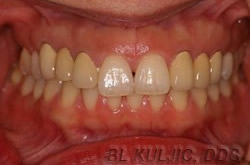
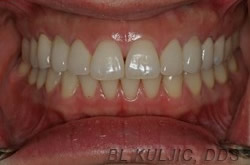
Orthodontics, implants, and whitening together
She was unhappy with an old restoration that never matched her other teeth, and she had ongoing discomfort through her face and neck. We aligned her teeth with orthodontics, brought them to the shade she wanted with home whitening, then replaced her bridges with two implants for a natural, comfortable result.
Treatment Steps & Timeline
Every implant case moves through the same four stages, from the first scan to the final tooth.
We capture a CBCT scan and digital impressions, then design your case on screen before anything is placed.
For a tooth in the smile zone, we plan a temporary so you are never left with a visible gap.
On the day of surgery, a surgical guide built from your scan positions the implant exactly where the plan calls for it.
If a failing tooth is still in place, we remove it and, in suitable cases, set the implant in the same visit. Where the bone is thin, we graft to rebuild it first. Most patients are back to their routine within a day or two.
Over the following weeks, your bone grows around the implant and locks it in place.
How long this takes depends on your anatomy and the type of case, and we give you clear aftercare to follow while it heals.
Once the implant is fused, we attach the abutment, take final impressions, and seat your custom crown or bridge.
We fine-tune how it meets the opposing teeth so your bite feels right, then coach you on protecting it for the long term.
Most patients find the procedure easier than they expected. Local anesthesia keeps placement comfortable, and sedation is available if you want it. Because the scan and the surgical guide map everything in advance, the surgery itself stays precise and quick, and a clear post-op plan keeps recovery short.
Living With Dental Implants: Care & Maintenance
An implant does not decay the way a natural tooth can, but the gum and bone around it still need daily care to stay healthy.
The routine is simple and takes only a few minutes a day.

Daily home care
Brush twice a day with a soft brush and a low-abrasive toothpaste. Clean around the implant crown or bridge with floss threaders or superfloss, and run an interdental brush with nylon-coated wire along the sides. A water flosser helps too, especially under bridges and full-arch restorations where debris collects.
If you wear an implant overdenture
Take the denture out and clean it daily. Brush the attachments that hold it, the locators or bar, along with the underside of the denture itself. Soak the liners as directed to keep buildup and odor down.
Professional maintenance
Most patients come in every three to six months for a cleaning, on a schedule we set to your risk factors. At those visits we check the tissue around each implant and take images from time to time to confirm everything below the gumline stays sound.
Protect your investment
If you grind or clench, a custom nightguard shields both your implants and your natural teeth while you sleep. Keep teeth off packaging and hard objects like ice. Smoking and untreated gum inflammation both raise the risk of peri-implant disease, so ask us for a prevention plan built around your habits.
Call us if you notice
Bleeding that does not stop, swelling, tenderness, a bad taste or odor, any looseness, or a change in the way your teeth meet. Caught early, small problems stay small.
Costs & Financing
What implant treatment costs depends on how many implants you need, whether the site calls for grafting first, and which final restoration goes on top, a single crown, a bridge, an overdenture, or a full arch.
After your exam and 3D scan, you receive a written estimate that lays out your options in plain numbers.
We help you apply any insurance benefits you have, and we offer flexible payment through our financing options and in-office wellness plan.
Why Kuljic DDS & Team
One team, one roof, no handoffs
The surgery that places your implant and the restoration that goes on top are planned by the same team, in the same office, from the first scan to the final tooth.
At practices that split the two, you get passed between offices and details slip in the gap. Here there is no gap to slip through.
Planned in 3D before we touch anything
A CBCT scanner maps your bone and the nerves around it, and a surgical guide built from that scan places the implant exactly where it was planned.
Digital impressions replace putty trays, so your final tooth fits the way it was designed to, not close enough.
Built around your whole bite
We plan the implant around how your teeth actually meet, not just the empty space. The finished tooth carries its share of the load, the teeth around it stay protected, and your bite feels like your own.
You get clear options, honest timelines, and a written cost before anything begins.
If dental implants are one part of the picture for you, see the full range of our restorative dentistry.
All of it from a team in Beverly that treats your case like it matters. Call (978) 922-4200 or request a consultation, and we will show you where to start.
Dental Implant FAQs
With good care and regular checkups, implants last for decades. The crown or bridge on top may need maintenance or replacement over the years, the same as any restoration on a natural tooth.
You are numb throughout placement. Most patients report mild soreness afterward that over-the-counter medication handles, and sedation is available if you want it.
Bone grafting rebuilds the volume you are missing, which makes implants possible in cases that would not support one otherwise. We confirm exactly what you need from your 3D scan.
Most patients return to routine activities within a day or two. Full osseointegration, where the bone fuses to the implant, takes weeks to months depending on your case.
Coverage varies by plan. We give you a written estimate and help you apply whatever benefits you have.
Implants involve surgery, healing time, and careful planning. They can call for added procedures like grafting, they cost more upfront than a bridge or denture, and like natural teeth they need good home care to avoid problems such as peri-implantitis. What you get for that investment is a replacement that stands on its own and lasts.
Often, yes. Depending on the tooth and your bite, options include a temporary crown, a clear retainer with a tooth attached, a removable flipper, or an interim bridge. In select cases we load a temporary onto the implant the day it is placed.
There is no upper age limit. What matters is general health and bone condition, not the number. For younger patients, we wait until the jaw finishes growing in the late teens, then plan implants as needed.
The common alternatives are a traditional bridge, a resin-bonded bridge in select cases, or a removable partial or full denture. Where the anatomy allows, closing the space with orthodontics is sometimes an option.
An outright no is rare. Implants may be deferred or ruled out with uncontrolled conditions like poorly managed diabetes, active gum disease, heavy smoking without a plan to reduce it, recent head or neck radiation, or certain bone medications. Severe bone loss may call for grafting first. Your consultation and 3D scan settle candidacy.