
Dental Crowns and Bridges in Beverly, MA
A damaged or missing tooth throws off more than your smile. It changes how your bite meets and forces the teeth around it to compensate.
A crown rebuilds a single damaged tooth from the outside in, and a bridge fills the space left by one or more missing teeth.
At Kuljic DDS & Team in Beverly, we fit every crown and bridge to the way your teeth actually come together, so the restoration protects the tooth, holds up to daily chewing, and looks like it belongs.
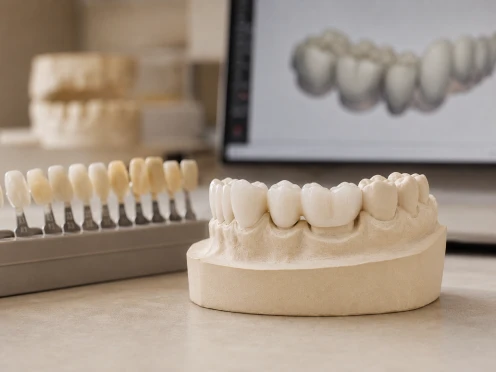
Dental Crown
When a tooth is too damaged for a filling but still has a healthy root, a crown rebuilds it. Here is what a crown does, when you need one, and what they are made of.
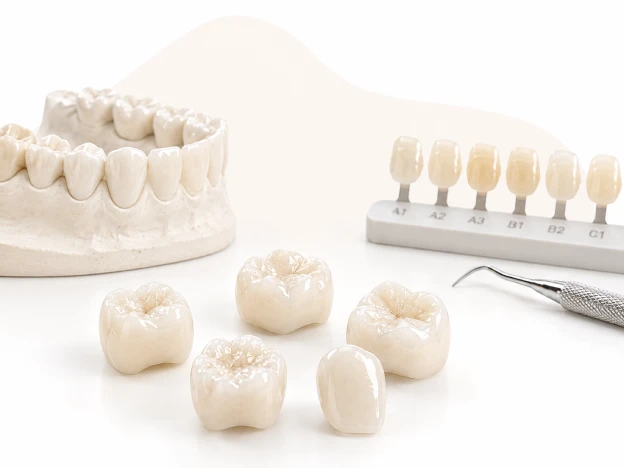
What Is a Dental Crown?
A dental crown is a custom cap that covers a tooth completely, restoring its shape, strength, and surface once decay or damage has taken too much of the natural structure. It sits over what remains of the tooth and takes on the full job of biting and chewing, the way the original enamel once did.
A crown also caps a dental implant or a tooth that has had root canal treatment, where the remaining tooth needs full coverage to stay protected. Whatever sits underneath, the crown is shaped and shaded to match the teeth on either side, so it reads as one of your own.
When You Might Need a Crown
A crown becomes the right choice when a tooth is too compromised for a filling to hold. We recommend one in several situations:
Types of Crowns and Materials
Not every crown is made of the same material. The right one depends on where the tooth sits, how much bite force it takes, and how visible it is.
At your consultation we walk through which material fits the tooth in question, and why. The goal is a crown that holds up under your bite and looks right for where it sits.
Dental Bridges
A bridge replaces teeth that are already gone, where a crown restores one that is damaged but still there. Here is how a bridge works, when it is the right choice, and the forms it takes.
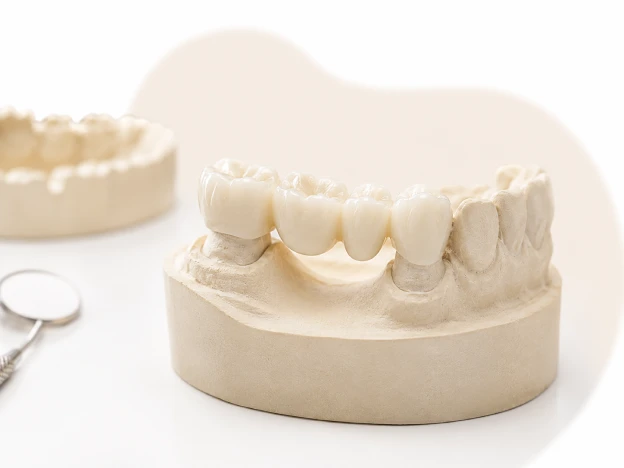
What Is a Dental Bridge?
A dental bridge fills the space left by one or more missing teeth. The replacement tooth, called a pontic, is held in place by the teeth on either side of the gap, which are crowned and act as anchors. Together they span the space as one fixed unit that does not come in and out of your mouth.
A bridge does more than close a gap for looks. When a tooth is missing, the ones around it drift toward the space and the bite above it drops down over time. A bridge holds those teeth in position and keeps your bite meeting the way it should.
When a Bridge Makes Sense
A bridge is a strong choice when the teeth on either side of a gap are healthy enough to carry it, or when you want a fixed replacement without surgery. It works well when a filling or crown alone cannot address a missing tooth, and when you want to restore chewing on that side of the mouth quickly.
A bridge is not always the better option, and we tell you when it is not. A dental implant replaces a missing tooth on its own root without touching the teeth beside it, which protects those neighbors and preserves the bone underneath.
When the adjacent teeth are healthy and untouched, an implant is often the more conservative long-term choice. When those teeth already need crowns anyway, a bridge puts them to work and treats both problems at once.
At your consultation we lay out both paths for your specific case, including how they compare on cost, timeline, and what each asks of the teeth around the gap.
Types of Bridges
Not every bridge is built the same way. The right type depends on where the gap sits, how many teeth are missing, and the condition of the teeth around it.
The Process
Getting a crown or a bridge takes two visits, with your custom restoration made between them. Here is how it goes.
We start with an exam and images to confirm a crown or bridge is the right fix, and to check the health of the tooth or the teeth around the gap.
We match the shade to your surrounding teeth and plan how the restoration will meet your bite.
For a crown, we shape the tooth so the cap fits over it precisely. For a bridge, we shape the anchor teeth on each side of the gap.
You are numb throughout, and we take a digital impression that captures the exact shape we are working with.
While your final crown or bridge is being made, a temporary one protects the prepared teeth and keeps them functional.
You leave with a working tooth, not an open gap.
At the second visit, we place your custom crown or bridge, check how it meets the opposing teeth, and adjust until the bite feels right.
Once it sits correctly, we bond it in place and fine-tune the finish.
Local anesthesia keeps both visits comfortable, and sedation is available if you want it. Because we plan the bite from the start, the final restoration settles into place instead of fighting how your teeth come together.
Care and Longevity
A crown or bridge does not decay, but the tooth and gum underneath still can. How you care for the restoration decides how long it lasts.
Daily care
Brush twice a day and floss once, the same as natural teeth. A bridge needs one extra step, cleaning underneath the pontic where a normal floss pass cannot reach. A floss threader or an interdental brush does this, and a water flosser helps around both crowns and bridges.
Protect the restoration
If you grind or clench at night, a custom nightguard keeps that force from cracking the porcelain or loosening the bond. Keep teeth off ice and hard objects, the same habits that protect natural teeth.
Regular checkups
At your cleanings we check the fit of the crown or bridge, the health of the tooth underneath, and the gum around it. Caught early, a small issue like a loosening edge is a simple fix rather than a lost restoration.
Lifespan of a crown or bridge
A well-cared-for crown or bridge lasts many years, often well over a decade. The porcelain surface can wear or the cement can loosen over time, the same as any restoration, and we replace or repair it when that day comes.
Real Patient Results
Every case below is crown and bridge work done in our office. Here is what each patient needed, and what we did about it.
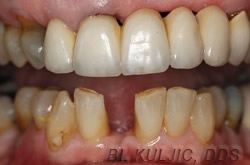
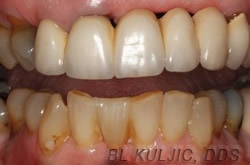
A missing front tooth restored with a Maryland bridge
She lost a lower front tooth to gum disease and wanted a replacement that stays put, not something she takes in and out.
Because lower front teeth are small and delicate, we placed a Maryland bridge that bonds to the teeth beside the gap, filling the space while saving the natural structure of those neighbors.
Old bridges replaced and the smile evened out
She was unhappy with the look of her old bridges and did not want implants. We replaced the existing bridges with new ones and added a few composite bondings to bring fullness and balance to her smile.
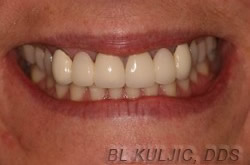
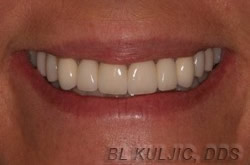
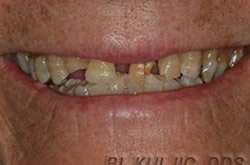
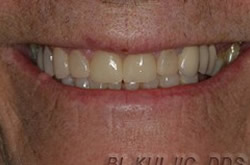
Full-mouth restoration with a bridge and bonding
Her daughter brought her in wanting a lasting result that was neither too costly nor too lengthy.
We restored her dentition with a short bridge in the upper left and composite bonding across the remaining teeth, keeping the treatment affordable while giving her back a smile she was happy to show.
When wear or tooth loss reaches across the whole mouth, see our approach to full-mouth reconstruction.
Crown and Bridge FAQs
A filling rebuilds a small part of a tooth and packs into the space left by decay. A crown covers the whole tooth. When too much of the natural structure is gone for a filling to hold, a crown takes over the full job of biting and protects what remains.
A regular crown caps a natural tooth that is still rooted in your jaw. An implant crown sits on a titanium post that replaces a missing tooth from the root up. The crown itself looks the same on top. What differs is what holds it: your own tooth, or an implant. If you are replacing a missing tooth rather than covering a damaged one, see how dental implants replace it.
It depends on the teeth around the gap. When the neighbors are healthy and untouched, an implant replaces the missing tooth without altering them, and it preserves the bone underneath. When those teeth already need crowns, a bridge treats both problems in one restoration. At your consultation we compare both for your case, including cost and timeline.
You are numb throughout the preparation, so the appointment itself is comfortable. Some tenderness afterward is normal and settles within a few days. Sedation is available if dental work makes you anxious.
Two in most cases. At the first, we prepare the tooth and fit a temporary. At the second, we place and adjust the final crown or bridge. We build the timeline around your case at the consultation.
Yes. We match the shade, shape, and size to the teeth around it, so an all-ceramic crown or bridge blends with your natural teeth. For a front tooth, where appearance matters most, we take extra care with the match.
Call us. A crown that loosens or an edge that lifts is usually a simple re-cement or repair if we catch it early. Left alone, the tooth underneath is exposed to decay, so it is worth a prompt visit rather than waiting.
If crowns and bridges are one part of the picture for you, see the full range of our restorative dentistry.
Whether a tooth needs protecting or a gap needs filling, we plan it around your whole bite, here in Beverly. Call (978) 922-4200 or request a consultation, and we will map out your options.